Browse other blogs
The 100-Meter Paper Trail: Stop Tracking 5,000 Tower Bolts on a Wet Clipboard

You’re standing at the base of a newly erected 3.0 MW turbine. The blades are pitched, the nacelle is secured, and the crane has already crawled to the next pad. Physically, it’s a marvel of modern engineering.
Financially, it’s a multi-million dollar paperweight.
Why? Because the mechanical completion walkdown is stalled. The commissioning team won't touch it until they see the foundation QA/QC sign-offs, the concrete break test results, and the torque logs for the thousands of flange bolts holding those tower sections together.
And right now, half of those logs are sitting on a smudged, coffee-stained clipboard in the back of a superintendent's pickup truck.
In wind construction, we build cutting-edge, grid-scale power plants, but we manage the quality control like it’s 1995. It’s time to kill the paper trail.
The Unique Burden of Wind QA/QC
Unlike other renewables, wind construction is unforgivingly sequential. You cannot cover up a mistake and fix it later.
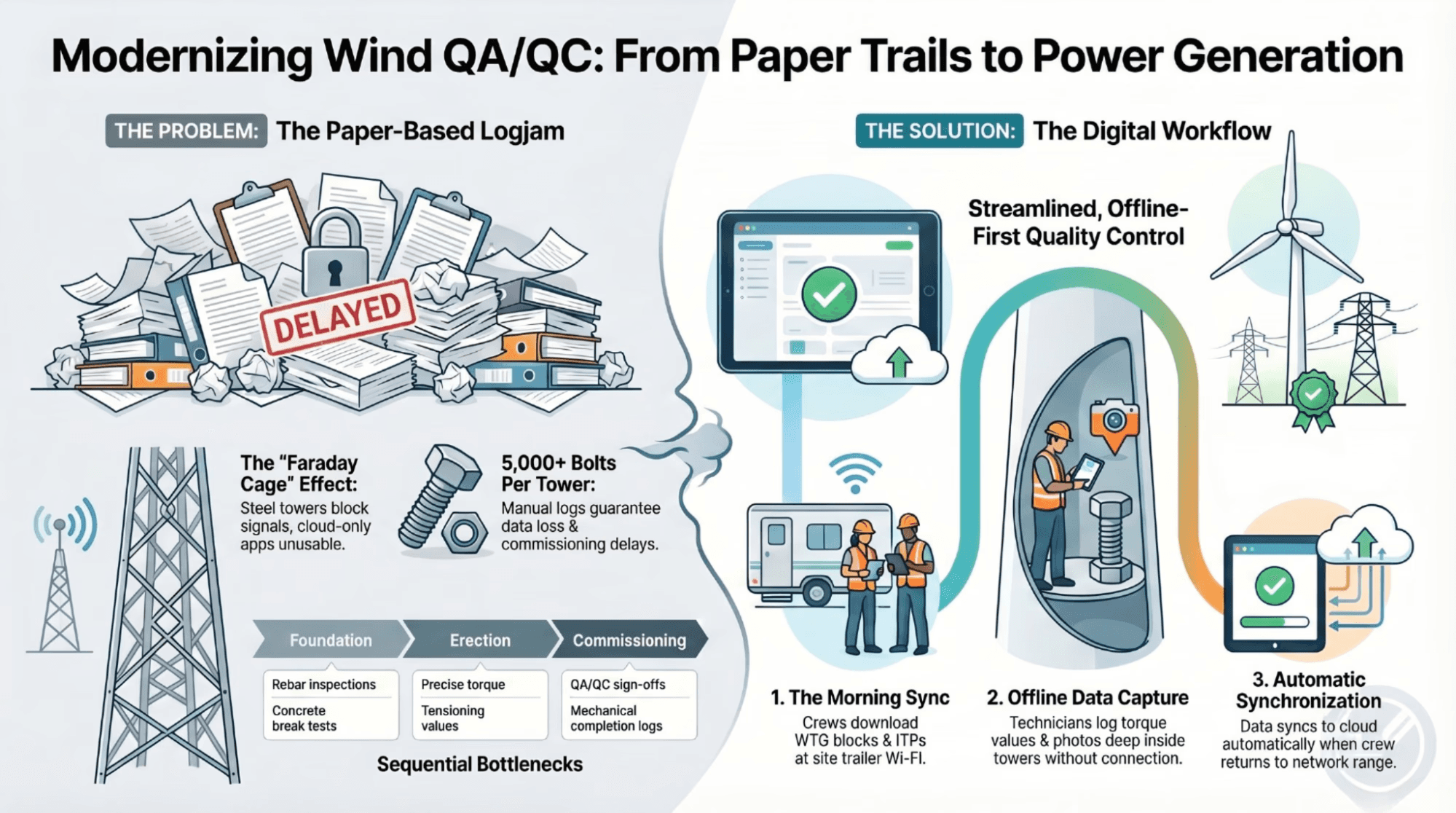
The Foundation Phase: Before you pour 400 cubic yards of concrete, every inch of that massive rebar cage needs to be inspected. If the sign-off isn't documented, you can't pour. If the pour isn't documented, you can't backfill.
The Erection Phase: Securing a tower section isn't just about putting nuts on threads. It requires precise torque and tensioning. Every single bolt's value needs to be recorded to satisfy the turbine manufacturer's warranty requirements.
When you try to manage this volume of critical data on paper, or through disconnected PDF forms, you are guaranteeing data loss, rework, and agonizing delays at mechanical completion.
The Faraday Cage Effect (The Offline Reality)
So, why are teams still using paper? Because most construction software fails in the real world.
Wind farms are built on remote ridgelines or isolated agricultural expanses. Furthermore, when your technicians are inside the base of a steel tower, they are effectively standing inside a Faraday cage. There is no 5G in there.
If your field app requires a cloud connection to save a torque value or upload a photo of a flange, your crews will abandon it on day one.
You’re standing at the base of a newly erected 3.0 MW turbine. The blades are pitched, the nacelle is secured, and the crane has already crawled to the next pad. Physically, it’s a marvel of modern engineering.
Financially, it’s a multi-million dollar paperweight.
Why? Because the mechanical completion walkdown is stalled. The commissioning team won't touch it until they see the foundation QA/QC sign-offs, the concrete break test results, and the torque logs for the thousands of flange bolts holding those tower sections together.
And right now, half of those logs are sitting on a smudged, coffee-stained clipboard in the back of a superintendent's pickup truck.
In wind construction, we build cutting-edge, grid-scale power plants, but we manage the quality control like it’s 1995. It’s time to kill the paper trail.
The Unique Burden of Wind QA/QC
Unlike other renewables, wind construction is unforgivingly sequential. You cannot cover up a mistake and fix it later.
The Foundation Phase: Before you pour 400 cubic yards of concrete, every inch of that massive rebar cage needs to be inspected. If the sign-off isn't documented, you can't pour. If the pour isn't documented, you can't backfill.
The Erection Phase: Securing a tower section isn't just about putting nuts on threads. It requires precise torque and tensioning. Every single bolt's value needs to be recorded to satisfy the turbine manufacturer's warranty requirements.
When you try to manage this volume of critical data on paper, or through disconnected PDF forms, you are guaranteeing data loss, rework, and agonizing delays at mechanical completion.
The Faraday Cage Effect (The Offline Reality)
So, why are teams still using paper? Because most construction software fails in the real world.
Wind farms are built on remote ridgelines or isolated agricultural expanses. Furthermore, when your technicians are inside the base of a steel tower, they are effectively standing inside a Faraday cage. There is no 5G in there.
If your field app requires a cloud connection to save a torque value or upload a photo of a flange, your crews will abandon it on day one.
Building the Digital Turbine
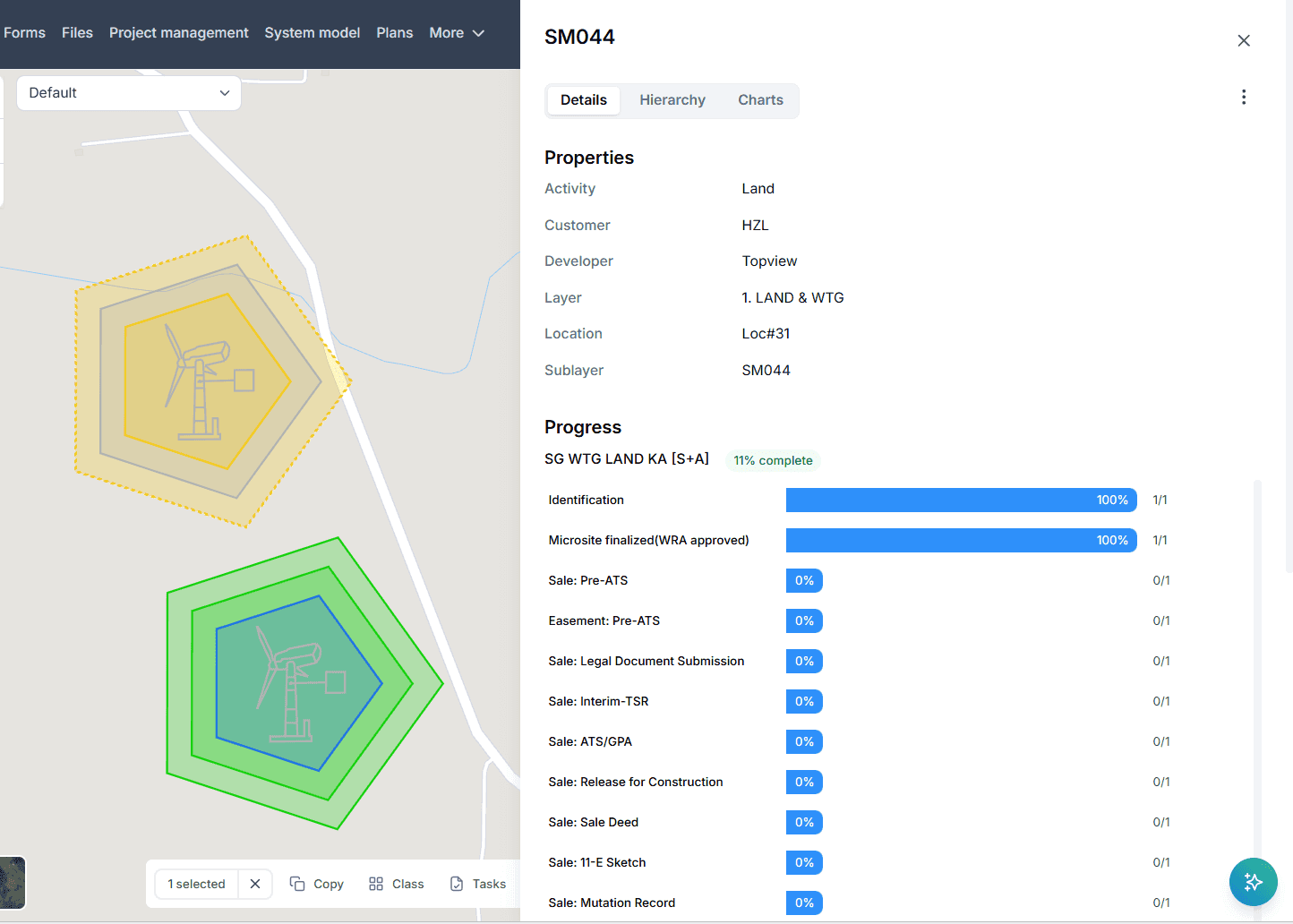
This is exactly why TaskMapper Mobile was engineered to be offline-first. It is built for the "dead zones." Here is how a modernized wind site operates:
Building the Digital Turbine
This is exactly why TaskMapper Mobile was engineered to be offline-first. It is built for the "dead zones." Here is how a modernized wind site operates:

The Morning Sync: In the site trailer (where the Wi-Fi lives), field engineers open the app. They download the specific WTG (Wind Turbine Generator) blocks they are working on, pulling down the latest foundation ITPs or mechanical checklists.
Deep in the Dead Zone: Out at the pad, the app works flawlessly offline. An inspector takes a photo of the rebar clearance—the app automatically stamps it with exact GPS coordinates, a timestamp, and the user's ID. A mechanical tech logs the torque values for the T1-to-T2 flange directly into a structured digital form.
The Return to the Trailer: The moment that truck drives back into network range, the magic happens. TaskMapper automatically syncs all the offline data to the cloud.
The Morning Sync: In the site trailer (where the Wi-Fi lives), field engineers open the app. They download the specific WTG (Wind Turbine Generator) blocks they are working on, pulling down the latest foundation ITPs or mechanical checklists.
Deep in the Dead Zone: Out at the pad, the app works flawlessly offline. An inspector takes a photo of the rebar clearance—the app automatically stamps it with exact GPS coordinates, a timestamp, and the user's ID. A mechanical tech logs the torque values for the T1-to-T2 flange directly into a structured digital form.
The Return to the Trailer: The moment that truck drives back into network range, the magic happens. TaskMapper automatically syncs all the offline data to the cloud.
The Morning Sync: In the site trailer (where the Wi-Fi lives), field engineers open the app. They download the specific WTG (Wind Turbine Generator) blocks they are working on, pulling down the latest foundation ITPs or mechanical checklists.
Deep in the Dead Zone: Out at the pad, the app works flawlessly offline. An inspector takes a photo of the rebar clearance—the app automatically stamps it with exact GPS coordinates, a timestamp, and the user's ID. A mechanical tech logs the torque values for the T1-to-T2 flange directly into a structured digital form.
The Return to the Trailer: The moment that truck drives back into network range, the magic happens. TaskMapper automatically syncs all the offline data to the cloud.

Stop Chasing Signatures
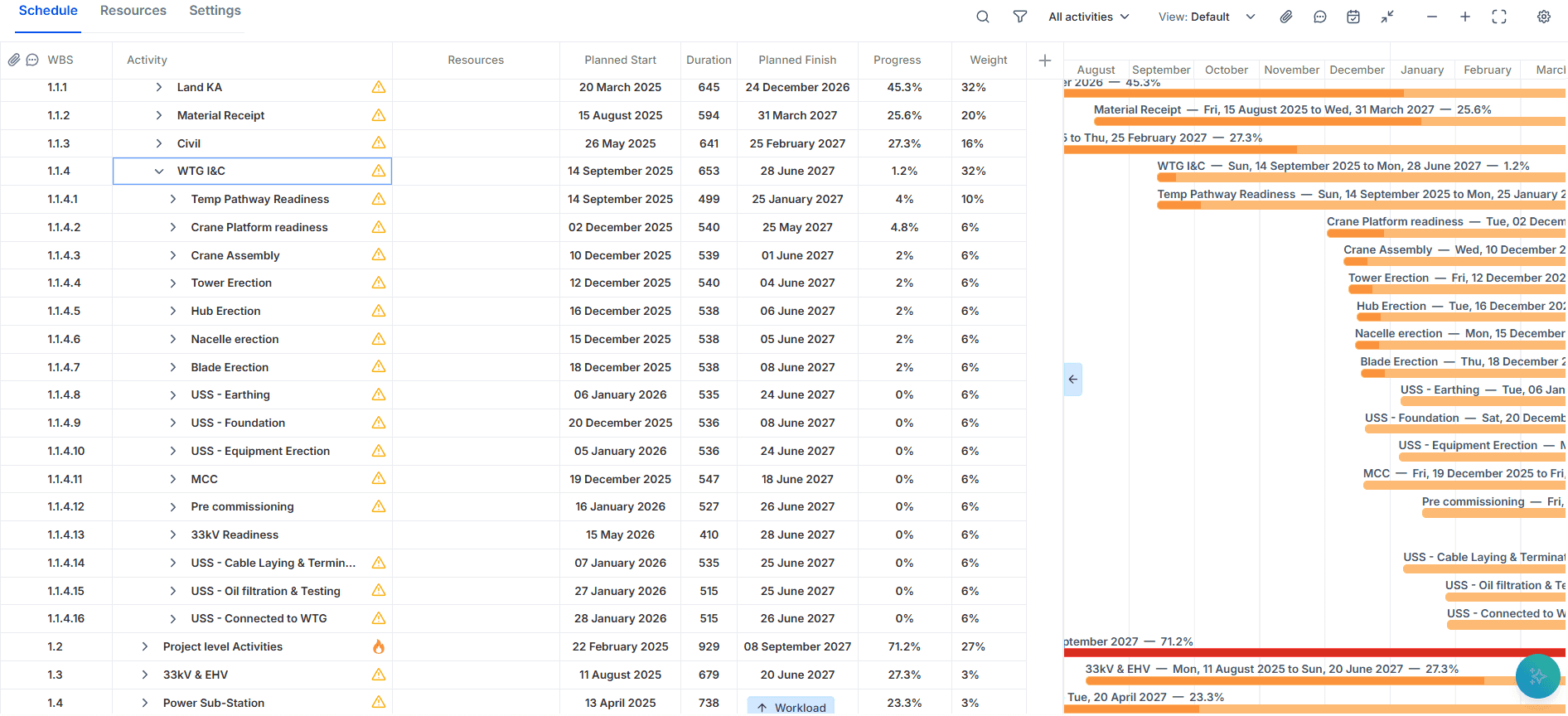
By the time the superintendent takes off their boots, the Project Manager can already see the completed torque logs and geotagged foundation photos on their dashboard. The digital twin of that specific WTG is updated in real-time.
You don't need to chase down signatures at the end of the month. You don't need highly-paid engineers doing manual data entry on a Friday night.
When you capture the data digitally at the exact moment the work happens, mechanical completion stops being a frantic scramble. The turbine is ready, the paperwork is already filed, and you can finally let that rotor spin.

To know how SenseHawk's TaskMapper platform can deliver next-gen construction and operations monitoring and management to connect your teams, drive efficiency improvements, and optimize processes, drop an email to contact@sensehawk.com.
Read More
To know how SenseHawk's TaskMapper platform can deliver next-gen construction and operations monitoring and management to connect your teams, drive efficiency improvements, and optimize processes, drop an email to contact@sensehawk.com.
Read More
We believe the SenseHawk digital workflow solution for our operating sites will result in substantial productivity gains for our O&M team. It is the type of innovation essential for scaling renewables.
Abhijit Sathe | Co-CEO
SB Energy
We believe the SenseHawk digital workflow solution for our operating sites will result in substantial productivity gains for our O&M team. It is the type of innovation essential for scaling renewables.
Abhijit Sathe | Co-CEO
SB Energy
We believe the SenseHawk digital workflow solution for our operating sites will result in substantial productivity gains for our O&M team. It is the type of innovation essential for scaling renewables.
Abhijit Sathe | Co-CEO
SB Energy
Vice President, Operations
Posted by


Karthik Mekala
Related Tags
Document Management System, Files, Transmittals, Submittal, Documentation
Vice President, Operations
Posted by


Karthik Mekala
Related Tags
Document Management System, Files, Transmittals, Submittal, Documentation
Vice President, Operations
Posted by
April 20, 2026
In the news
TaskMapper Solar
Products
TaskMapper Solar
Products
TaskMapper Solar