Products

Resources

Company

Product

Resources

Company

Book a Demo

Browse other blogs

The Death of the Static Dashboard: Why Solar Construction Needs a Decision Engine, Not Just a Report

We need to talk about the "Monday Morning Report."

You know the one. It arrives in your inbox as a PDF or a heavy slide deck. It’s filled with beautiful charts, S-curves, and completion percentages. It looks professional, but it has a fatal flaw: by the time you read it, the data is already four days old.

Worse, it only answers one question: “What happened last week?”

It doesn’t tell you why a specific block is stalling. It doesn’t tell you which contractor is driving the sudden spike in NCRs. And it definitely doesn't tell you what will happen next week if you don't intervene today.

So, what do your planners do? They resort to the industry standard workaround: They hit "Export to Excel," spend four hours wrangling disparate data, and build their own "version of the truth."

This inefficiency is exactly why we built TaskMapper BI.
Why Traditional BI Fails on Solar Sites

Most Business Intelligence (BI) tools are built for corporate business reporting, not the chaotic reality of a construction site. They are designed for clean, static data sets and predictable, recurring questions.

Solar construction is the exact opposite:

  • Data changes daily (and sometimes hourly).

  • Context is everything (Location, Weather, Contractor Performance, Asset History).

  • The questions evolve as the project moves from civil to mechanical to commissioning.

When you try to force dynamic construction data into a static dashboard, you lose the insight. You get a scorecard, but you don't get a game plan.


Breaking Down the Data Silos

The root cause of poor decision-making isn't usually a lack of data; it's that the data lives in disconnected silos. Your schedule is in P6, your design is in CAD, your material tracking is in an ERP, and your field progress is captured on clipboards or disparate apps.

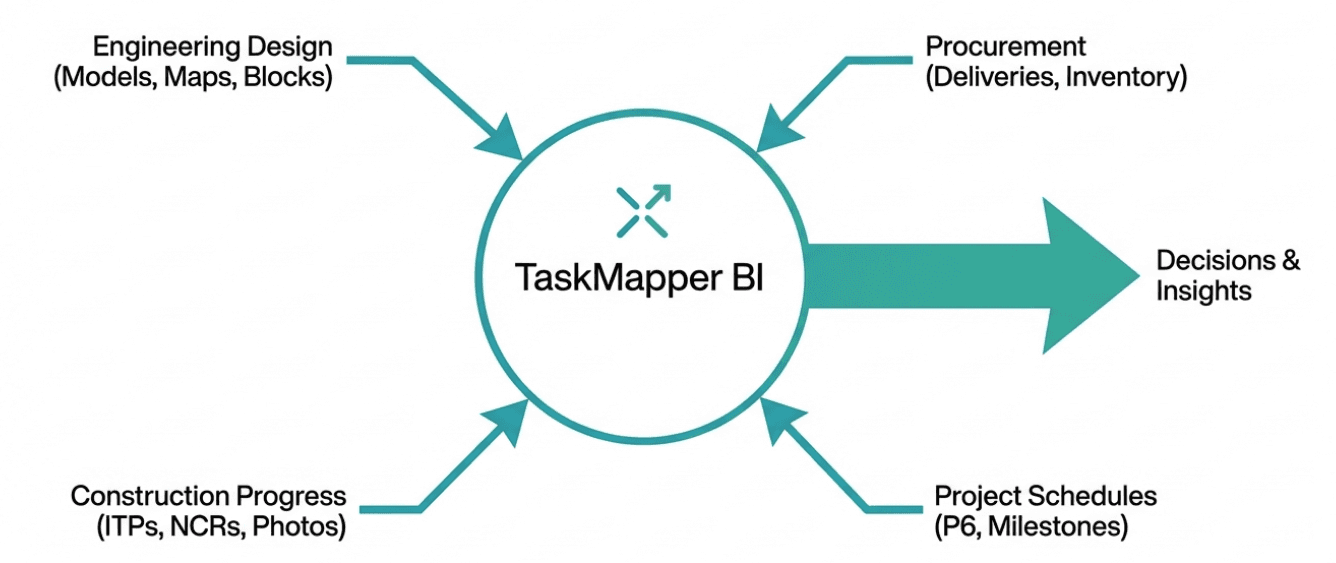
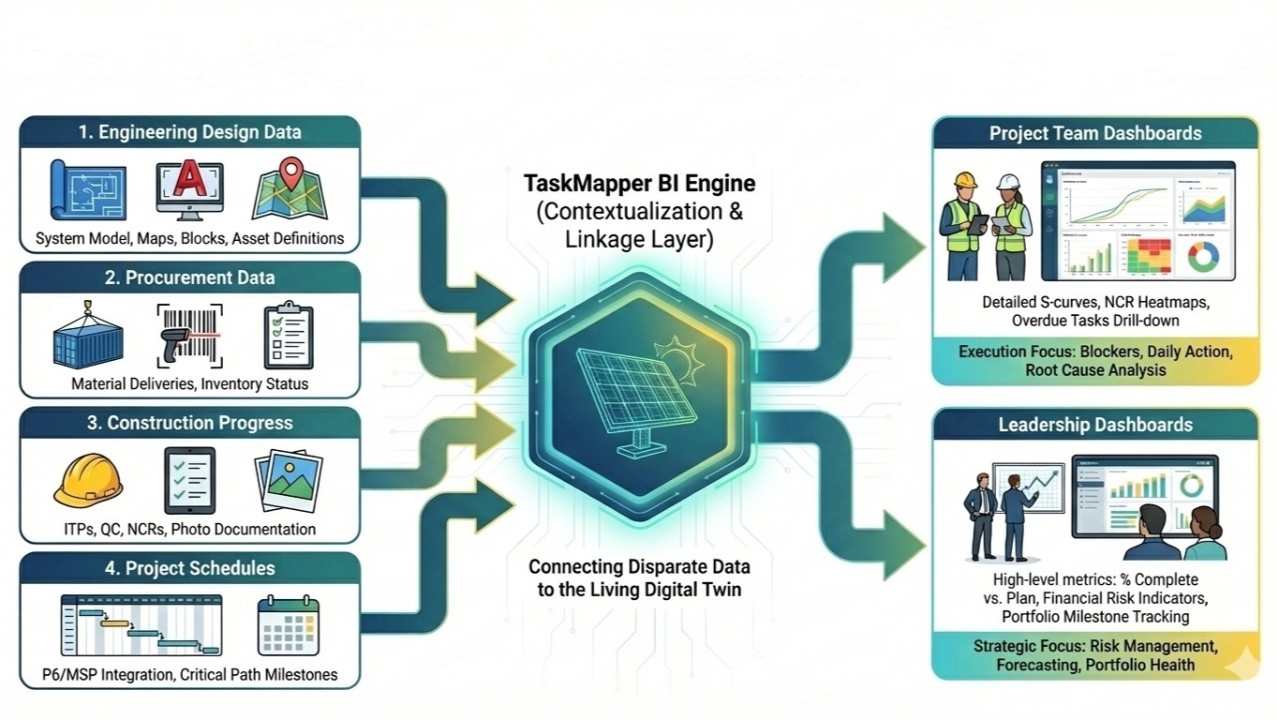
TaskMapper BI wasn’t designed to just "visualize field data." It was designed to be the integration engine that contextualizes the entire project lifecycle. It consumes and links four critical data streams:

  1. Engineering Design Data: Ingesting the system model, maps, blocks, and asset definitions to provide deep geospatial context.

  2. Procurement Data: Tracking material deliveries and inventory status relative to actual installation needs.

  3. Construction Progress: A real-time feed of ITPs, QC checklists, NCRs, and photo documentation from the field app.

  4. Project Schedules: Integrating P6 or MS Project timelines to measure actual progress against planned milestones.


The Power of Linked Data


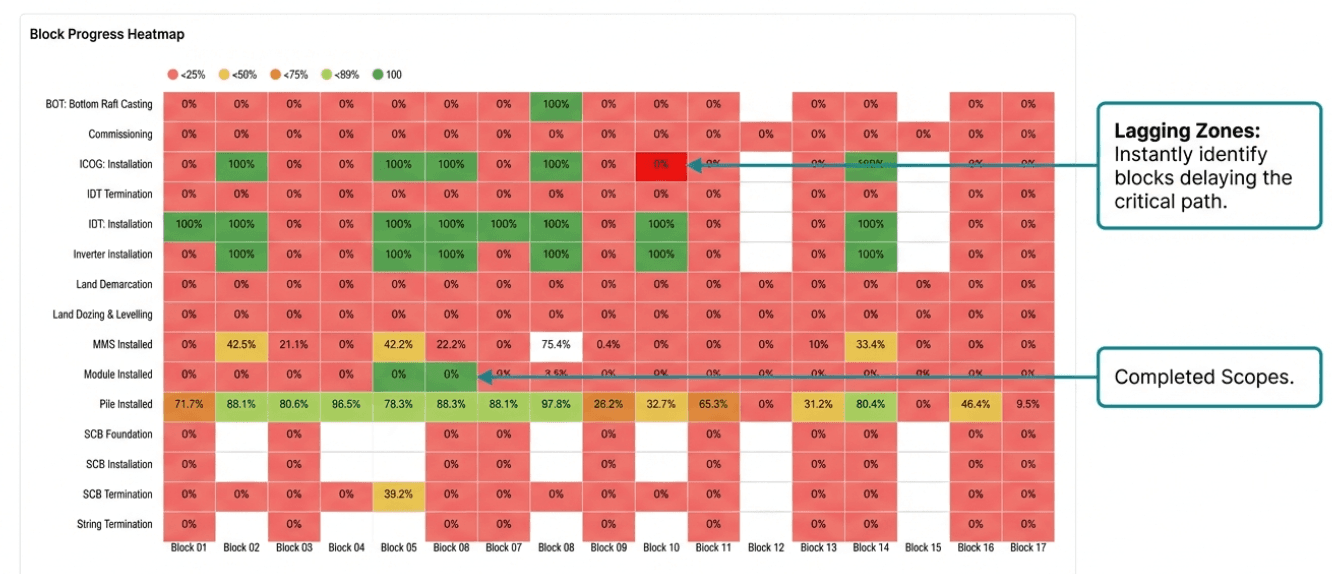
By linking these streams together against the Digital Twin, the narrative changes. You don't just see that a task is late; you see why it is late. For example, the system can reveal that a delay in Zone 4 is caused by materials that haven't arrived according to the procurement log, which is now impacting the critical path.


Tailored Views for Every Stakeholder


One of the core philosophies behind TaskMapper BI is that different roles need different levels of granularity.


For Project Teams: Execution Focus


We wanted to help teams stop reporting and start drilling down.


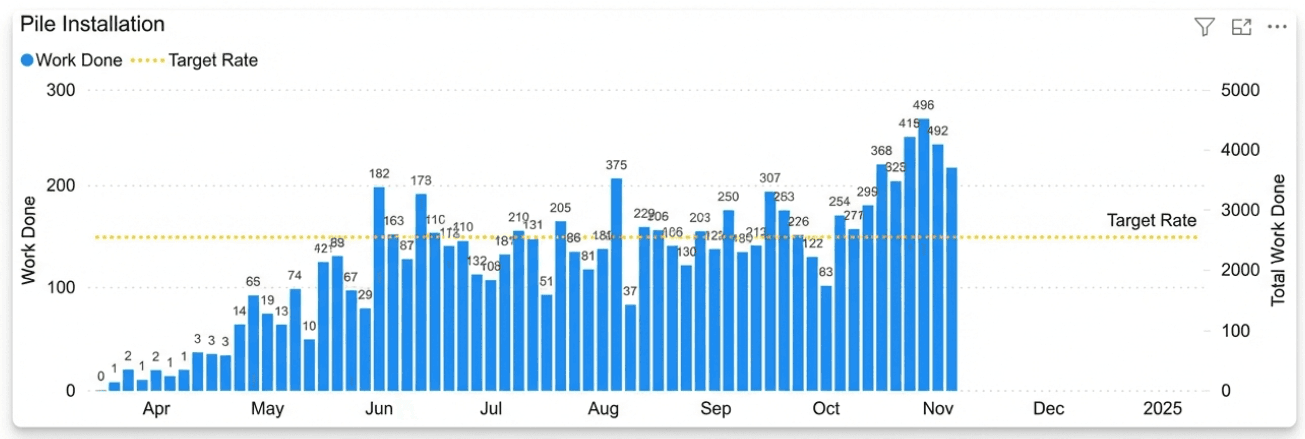
  • From Trend to Root Cause: If you see a spike in mechanical NCRs on a chart, you can click into it.

  • Deep Dive: Instantly see the affected piles, identify the contractor responsible, and view the actual photos from the field.

  • Speed: You go from a "high-level trend" to "root cause" in three clicks.

For Leadership: Strategic Focus


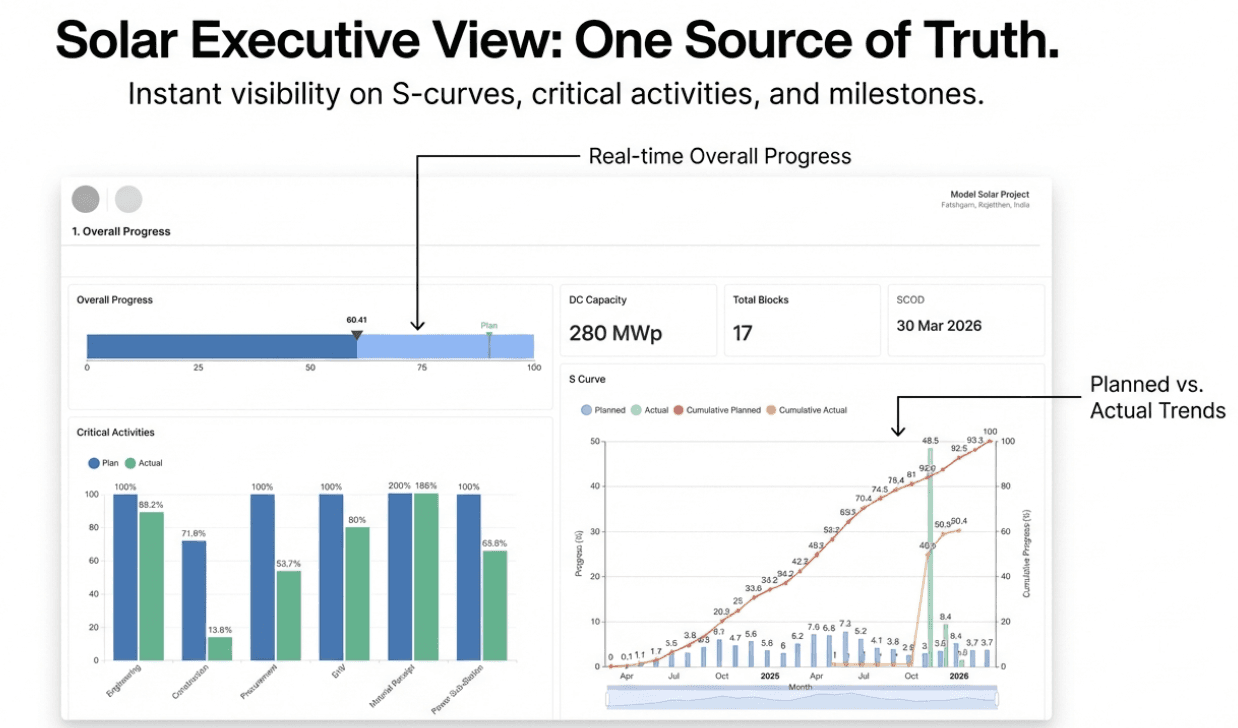
Executives need a real-time view of portfolio health without waiting for weekly slide decks.


  • Portfolio Health: See instantly if projects are trending toward milestone completion.

  • Risk Mitigation: Identify if procurement delays are creating future risk, allowing for proactive intervention rather than reactive firefighting.


The End of "Version Control" Hell


We are all tired of files named Project_Schedule_Final_v3_UPDATED.xlsx.


Because TaskMapper BI is built on top of the live TaskMapper platform and integrated data sources, everyone—from the site supervisor to the VP of Construction—is looking at the same reality. There is only one version of the truth, and it is updated in real-time.

A Note on the Team Behind It


TaskMapper BI didn’t come from a generic software roadmap. It was built in under 90 days by a focused, cross-functional team of product managers, engineers, and solar domain experts—many of whom have spent years working directly with solar EPCs and operators.


Their goal wasn’t to recreate a traditional BI tool. It was to build something purpose-built for renewable energy projects, grounded in real construction workflows and real field data.


Conclusion


As we head into 2026, solar projects are becoming too large and too complex to rely on siloed data and static reporting. Insights shouldn't live in a slide deck that gets archived. They should live where the work happens, powered by data from across the entire project spectrum.


TaskMapper BI represents a shift—from reporting on the past to actively shaping what happens next.


To know how SenseHawk's TaskMapper platform can deliver next-gen construction and operations monitoring and management to connect your teams, drive efficiency improvements, and optimize processes, drop an email to contact@sensehawk.com.

Read More

To know how SenseHawk's TaskMapper platform can deliver next-gen construction and operations monitoring and management to connect your teams, drive efficiency improvements, and optimize processes, drop an email to contact@sensehawk.com.

Read More

To know how SenseHawk's TaskMapper platform can deliver next-gen construction and operations monitoring and management to connect your teams, drive efficiency improvements, and optimize processes, drop an email to contact@sensehawk.com.

Read More

We believe the SenseHawk digital workflow solution for our operating sites will result in substantial productivity gains for our O&M team. It is the type of innovation essential for scaling renewables.

Abhijit Sathe | Co-CEO

SB Energy

We believe the SenseHawk digital workflow solution for our operating sites will result in substantial productivity gains for our O&M team. It is the type of innovation essential for scaling renewables.

Abhijit Sathe | Co-CEO

SB Energy

We believe the SenseHawk digital workflow solution for our operating sites will result in substantial productivity gains for our O&M team. It is the type of innovation essential for scaling renewables.

Abhijit Sathe | Co-CEO

SB Energy

Vice President, Operations

Posted by

Karthik Mekala

Related Tags

Vice President, Operations

Posted by

Karthik Mekala

Related Tags

Vice President, Operations

Posted by

January 12, 2026

In the news