

Browse other blogs
The "Real-Time" Lie: Why Your Executive Dashboard is Just a Historical Archive
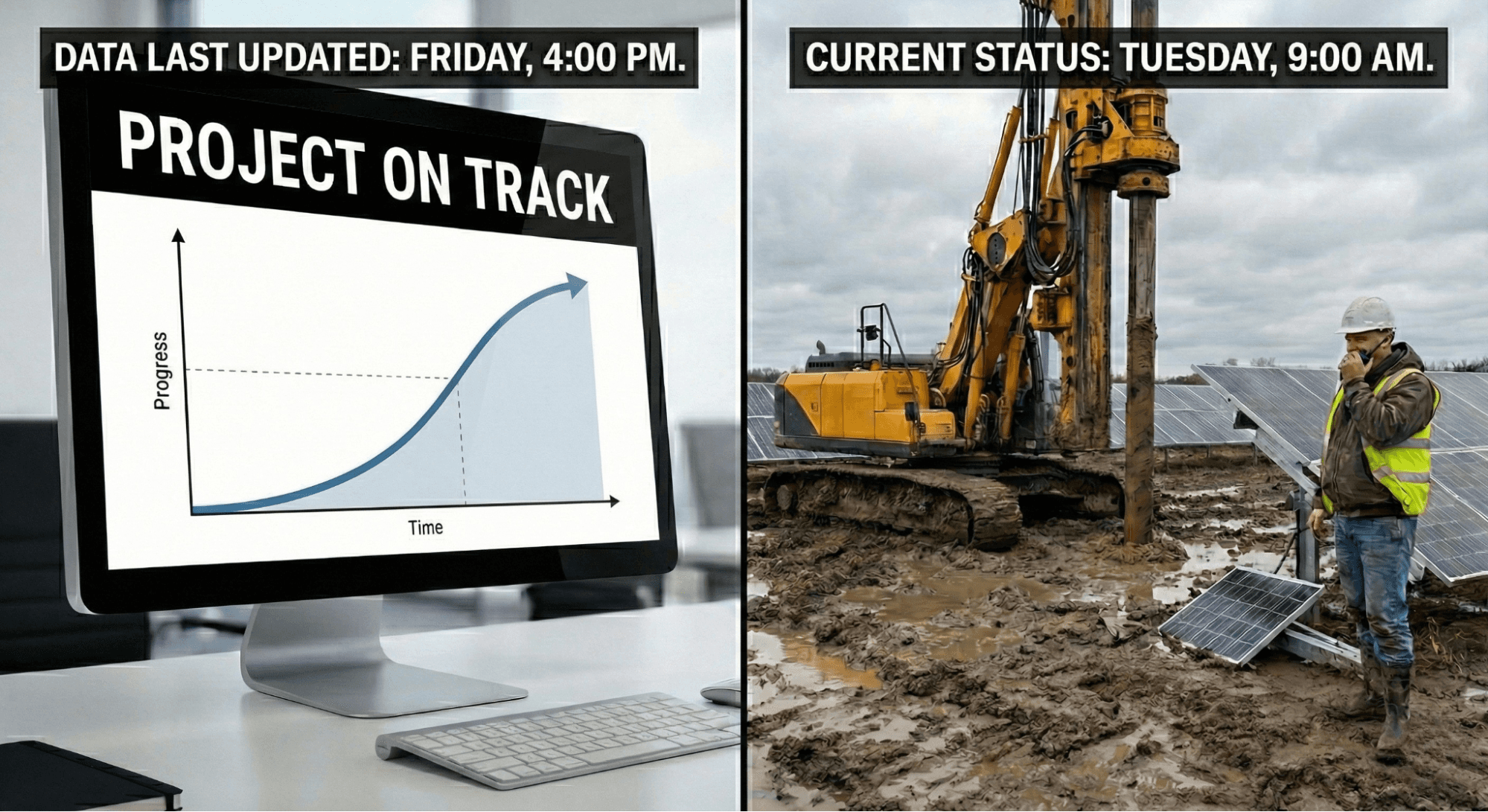
Walk into any construction executive’s office, and you will likely see a beautiful dashboard on a large screen. There are gauges for budget, charts for progress, and maps showing site activity. It looks like a cockpit. It feels like control.
But there is a hidden danger lurking behind those glossy charts.
If you are steering a multimillion-dollar solar project based on that dashboard, you are likely driving looking solely in the rear-view mirror.
Walk into any construction executive’s office, and you will likely see a beautiful dashboard on a large screen. There are gauges for budget, charts for progress, and maps showing site activity. It looks like a cockpit. It feels like control.
But there is a hidden danger lurking behind those glossy charts.
If you are steering a multimillion-dollar solar project based on that dashboard, you are likely driving looking solely in the rear-view mirror.
The Anatomy of Data Latency
We live in a world of instant information, so we assume our project dashboards are "real-time." In construction, they rarely are.
In most organizations, the journey data takes from the field to the boardroom is painfully slow:
Tuesday: Data is collected in the field (often on paper or isolated apps).
Friday: A Project Engineer spends hours manually exporting, cleaning, and aggregating that data into Excel.
Monday Morning: The aggregated data is turned into a PowerPoint or uploaded to a BI dashboard for leadership review.
The dashboard might look cutting-edge, but the information it displays is already 72 to 96 hours old. That gap is called Data Latency, and on a fast-moving solar site, it’s expensive.
The Anatomy of Data Latency
We live in a world of instant information, so we assume our project dashboards are "real-time." In construction, they rarely are.
In most organizations, the journey data takes from the field to the boardroom is painfully slow:
Tuesday: Data is collected in the field (often on paper or isolated apps).
Friday: A Project Engineer spends hours manually exporting, cleaning, and aggregating that data into Excel.
Monday Morning: The aggregated data is turned into a PowerPoint or uploaded to a BI dashboard for leadership review.
The dashboard might look cutting-edge, but the information it displays is already 72 to 96 hours old. That gap is called Data Latency, and on a fast-moving solar site, it’s expensive.
The "Tuesday Disaster" Scenario
Here is what data latency looks like in practice:
On Tuesday morning, a piling crew hits unexpected subsurface rock in Block 4. Their refusal rate spikes from 2% to 25%. This is a critical issue that requires immediate engineering intervention and a potential change order.
However, because that data sits in a siloed spreadsheet, nobody in the office sees the aggregate trend yet.
Wednesday-Friday: The crew keeps working, generating hundreds of piles that will likely need rework or extraction.
Monday Morning: The executive dashboard finally updates. The Director of Construction sees the red spike in refusal rates.
The Latency Tax
By the time the decision-makers see the problem, six days have passed. Six days of continued bad installation. Six days of lost mitigation time.
The data existed on Tuesday. But because it was disconnected and required manual handling, it didn't become intelligence until the following week.
You cannot manage modern construction risk on a five-day delay. If your data isn't flowing automatically from the field to your dashboard, you aren't managing a project in real-time—you are just reading the history books.
The "Tuesday Disaster" Scenario
Here is what data latency looks like in practice:
On Tuesday morning, a piling crew hits unexpected subsurface rock in Block 4. Their refusal rate spikes from 2% to 25%. This is a critical issue that requires immediate engineering intervention and a potential change order.
However, because that data sits in a siloed spreadsheet, nobody in the office sees the aggregate trend yet.
Wednesday-Friday: The crew keeps working, generating hundreds of piles that will likely need rework or extraction.
Monday Morning: The executive dashboard finally updates. The Director of Construction sees the red spike in refusal rates.
The Latency Tax
By the time the decision-makers see the problem, six days have passed. Six days of continued bad installation. Six days of lost mitigation time.
The data existed on Tuesday. But because it was disconnected and required manual handling, it didn't become intelligence until the following week.
You cannot manage modern construction risk on a five-day delay. If your data isn't flowing automatically from the field to your dashboard, you aren't managing a project in real-time—you are just reading the history books.
The "Tuesday Disaster" Scenario
Here is what data latency looks like in practice:
On Tuesday morning, a piling crew hits unexpected subsurface rock in Block 4. Their refusal rate spikes from 2% to 25%. This is a critical issue that requires immediate engineering intervention and a potential change order.
However, because that data sits in a siloed spreadsheet, nobody in the office sees the aggregate trend yet.
Wednesday-Friday: The crew keeps working, generating hundreds of piles that will likely need rework or extraction.
Monday Morning: The executive dashboard finally updates. The Director of Construction sees the red spike in refusal rates.
The Latency Tax
By the time the decision-makers see the problem, six days have passed. Six days of continued bad installation. Six days of lost mitigation time.
The data existed on Tuesday. But because it was disconnected and required manual handling, it didn't become intelligence until the following week.
You cannot manage modern construction risk on a five-day delay. If your data isn't flowing automatically from the field to your dashboard, you aren't managing a project in real-time—you are just reading the history books.
To know how SenseHawk's TaskMapper platform can deliver next-gen construction and operations monitoring and management to connect your teams, drive efficiency improvements, and optimize processes, drop an email to contact@sensehawk.com.
Read More
To know how SenseHawk's TaskMapper platform can deliver next-gen construction and operations monitoring and management to connect your teams, drive efficiency improvements, and optimize processes, drop an email to contact@sensehawk.com.
Read More
We believe the SenseHawk digital workflow solution for our operating sites will result in substantial productivity gains for our O&M team. It is the type of innovation essential for scaling renewables.
Abhijit Sathe | Co-CEO
SB Energy
We believe the SenseHawk digital workflow solution for our operating sites will result in substantial productivity gains for our O&M team. It is the type of innovation essential for scaling renewables.
Abhijit Sathe | Co-CEO
SB Energy
We believe the SenseHawk digital workflow solution for our operating sites will result in substantial productivity gains for our O&M team. It is the type of innovation essential for scaling renewables.
Abhijit Sathe | Co-CEO
SB Energy
Vice President, Operations
Posted by

Karthik Mekala
Related Tags
Document Management System, Files, Transmittals, Submittal, Documentation
Vice President, Operations
Posted by
Karthik Mekala
Related Tags
Document Management System, Files, Transmittals, Submittal, Documentation
Vice President, Operations
Posted by
February 23, 2026
In the news



TaskMapper Solar
Products
TaskMapper Solar
Products
TaskMapper Solar